
TL;DR
Pilates instructor Ashleigh Doyle recommends five beginner-friendly moves to practise at home: pelvic curls, knee folds, swan dive prep, side-lying leg lifts and cat stretch. The exercises introduce controlled movement, core stability, spinal mobility and hip strength; Doyle advises beginners to focus on form and reduce the movement if their back or pelvis shifts.
Pilates instructor Ashleigh Doyle recommends five basic moves for people starting Pilates at home: pelvic curls, knee folds, swan dive prep, side-lying leg lifts and cat stretch. The Fit&Well report presents the exercises as a way to practise controlled movement, core stability and spinal mobility before moving on to a longer routine.

Get oils, diffusers and self-care delivered free with Prime
- Fast, free delivery on millions of items
- Prime Video, Amazon Music and more included
- Member-only deals all year
Doyle, who works with beginners, says the exercises build familiarity with Pilates fundamentals rather than requiring complex choreography or equipment. The report suggests eight to 10 repetitions for each move; knee folds and side-lying leg lifts are done on both sides. It does not prescribe a weekly schedule or say that the routine is suitable for every person.
The sequence begins on the back. For a pelvic curl, a person starts with knees bent and feet hip-width apart, then gradually lifts and lowers the spine while keeping weight on the shoulders rather than the neck. In a knee fold, one bent leg lifts until the shin is parallel to the floor and returns to the mat. Doyle advises making that leg movement smaller if the lower back arches or the pelvis rocks.
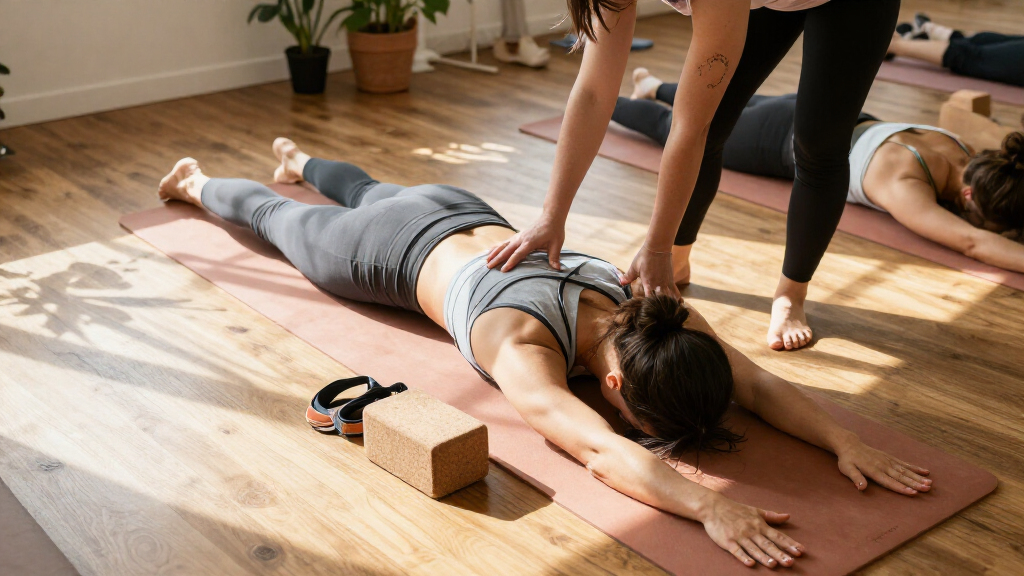
The other exercises cover different positions and movement goals. In swan dive prep, a person lies face down and gently raises the head and upper chest; Doyle’s cue is to reach forward before lifting upward. A side-lying leg lift targets control around the hips and pelvis, with the shoulders and hips kept stacked. In cat stretch, the person rounds the spine on hands and knees, then returns to neutral, aiming to move through the spine rather than concentrating the motion in the lower back.
Five Moves Focus on Pilates Basics
The recommendations give new practitioners a defined starting point without presenting Pilates as a test of flexibility or endurance. Each exercise uses a slow, deliberate movement and a manageable position, which can help beginners pay attention to how their spine, pelvis and limbs move. The emphasis is on learning control, not on completing repetitions at speed.
The cues also offer practical ways to adjust effort: reduce the range of motion if the pelvis shifts during a knee fold, and keep the neck and shoulders comfortable during the curl and chest lift. That may make the routine easier to adapt at home, though the article does not claim the exercises prevent or treat pain, or that they replace instruction tailored to an individual.
Products Worth Considering

Garmin Forerunner 165 GPS Running Smartwatch, 43 mm, Black

Therabody Theragun Mini 3rd Generation Massage Gun, Black

Oura Ring 5 Smart Ring, Silver, Size 8
As an affiliate, we earn on qualifying purchases.
A Short Routine Before Progression
The Fit&Well report frames the five exercises for people who are new to exercise or returning after a break. Its central point is that simple movements can help practitioners learn the precision and control used in Pilates. Doyle links the pelvic curl to awareness of spinal and pelvic movement, and describes knee folds as practice in stabilising the trunk while moving the legs independently.
The report says readers who have mastered the five moves can try a separate, longer eight-move beginner routine. It provides no information about how mastery should be judged, how quickly someone should progress, or whether the exercises are part of a formal class plan. The suggested repetitions are guidance from the article, not an individual assessment.
“The pelvic curl is a brilliant introduction to Pilates because it encourages you to slow down and become aware of how your spine and pelvis are moving.”
— Ashleigh Doyle, Pilates instructor, as quoted by Fit&Well
Who Should Adapt the Exercises
The report does not specify whether the routine is appropriate for people with injuries, persistent pain, pregnancy-related needs or other health conditions. It also does not provide video-based form checks, alternatives for every movement, or guidance on how often to practise. Readers who have a health concern or are unsure whether an exercise is suitable can seek advice from a qualified health professional or Pilates instructor before trying it.
The recommendations are attributed to Doyle through Fit&Well; the source material does not include independent testing or evidence that the five-move sequence produces particular health outcomes. The routine should be understood as beginner exercise guidance, not as medical advice.
Practising Before Adding More Moves
Fit&Well points readers who have become comfortable with these five exercises to its separate eight-move beginner routine. The report gives no timetable for that progression. For now, its guidance is to use controlled repetitions, keep movements within a comfortable range and pay attention to the alignment cues for each exercise.
Anyone who experiences pain or finds it difficult to maintain a comfortable position should stop and seek appropriate guidance rather than pushing through. The source does not announce a class, follow-up study or other scheduled development; the next step described is simply progressing to a longer routine when ready.
Key Questions
Which five Pilates moves does Ashleigh Doyle recommend?
Doyle recommends pelvic curls, knee folds, swan dive prep, side-lying leg lifts and cat stretch as beginner-friendly moves to practise at home.
How many repetitions does the report suggest?
The report generally suggests eight to 10 repetitions. Knee folds and side-lying leg lifts are performed on each side.
What should a beginner do if their back arches during a knee fold?
Doyle advises making the movement smaller if the lower back arches or the pelvis rocks as the leg lifts.
Does the report say how often to do the routine?
No. It lists repetition guidance but does not give a weekly schedule or practice frequency.
When should someone move on to a longer routine?
Fit&Well suggests trying a separate eight-move beginner routine after becoming comfortable with the five exercises, but it does not define a timetable or specific test for readiness.
Source: fitandwell.com