
TL;DR
A 12-week trial at Penn State College of Medicine tested a four-minute daily strength routine with inactive adults over 65 who had difficulty walking. Researchers reported strength improvements, but the source does not provide effect sizes or evidence that the workout improved walking ability or aging outcomes.
A 12-week trial led by Penn State College of Medicine found that inactive adults over 65 with pre-existing walking difficulties increased their strength after completing a four-minute daily workout. The finding suggests a short routine may offer a manageable starting point for some older adults, though the available report does not establish that it improves walking ability or prevents age-related decline.

Get oils, diffusers and self-care delivered free with Prime
- Fast, free delivery on millions of items
- Prime Video, Amazon Music and more included
- Member-only deals all year
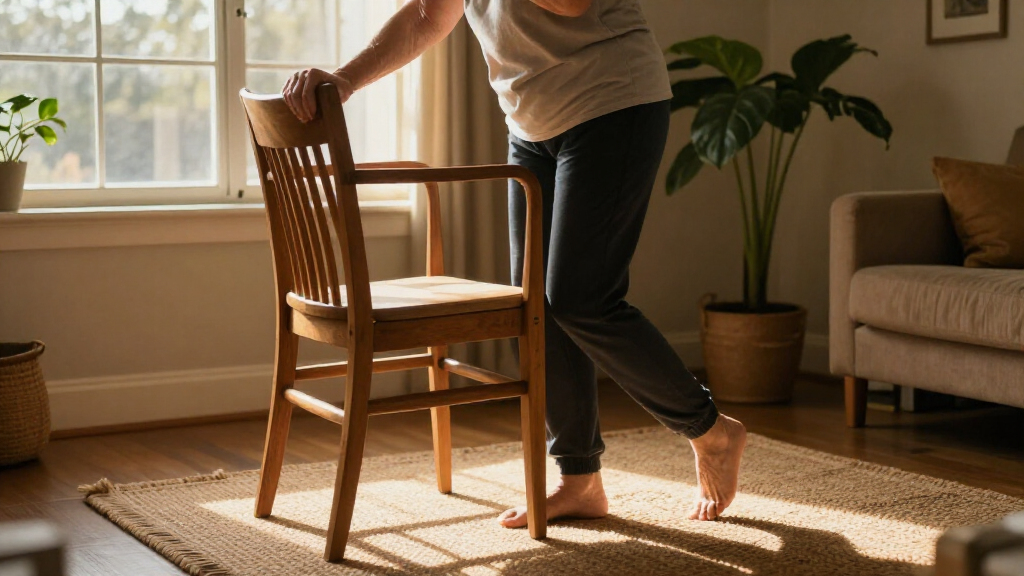
The routine, called Functional Activity Strength Training (FAST-2), consisted of four exercises: a push-up variation, chair stands, seated two-arm rows using resistance bands and stair stepping. Participants performed each exercise for 30 seconds, completing as many repetitions as they could, and rested for 30 seconds before moving to the next exercise. The source describes the workout as four minutes in total.
The study enrolled inactive adults over 65 with an existing walking difficulty and followed them for 12 weeks. According to the Fit&Well report, researchers found that participants increased their strength. The source does not give the number of participants, the size of the strength gains, the testing method or a comparison group’s results, limiting what can be concluded from the summary.
Researchers offered easier versions of some movements. Push-ups could be done against a wall, on an incline such as a counter, or from the knees; participants could use their hands on their knees during chair stands if necessary. For rows, the study supplied bands offering resistance from 10 to 40 pounds. Step height could be adjusted, with participants told to increase it after completing six step-ups in 30 seconds.
A Shorter Route Into Strength Training
The trial addresses a practical barrier: adults with limited mobility may find longer or more demanding exercise plans difficult to begin. A brief, adaptable routine could make strength work feel more attainable for some people, particularly when movements can be modified to match ability.
But the result should be read narrowly. The reported outcome was increased strength; the source does not say that participants walked faster, needed less assistance, avoided falls or experienced better overall health. Nor does it show that four minutes of exercise can replace broader activity recommendations. The study offers a possible entry point, not evidence that one short routine meets every older adult’s needs.
Products Worth Considering

Levoit Vital 100S-P Air Purifier for Home and Pets

Therabody WaveDuo Contoured Vibrating Back and Neck Roller

Oral-B iO3 Rechargeable Electric Toothbrush with 3 Cleaning Modes, Pressure Sensor, 2 Brush Heads and Travel Case, White
As an affiliate, we earn on qualifying purchases.
How FAST-2 Was Structured
The Fit&Well report notes that the U.S. Centers for Disease Control and Prevention recommends adults get two sessions of resistance exercise per week, alongside 150 minutes of moderate aerobic activity. The article frames FAST-2 as a test of whether a much shorter daily strength routine could still produce a measurable benefit for a group facing walking difficulties.
Study participation had limits. Researchers did not enroll people who were unable to walk without equipment, and participants received periodic coaching by video call. Those details matter: the results may not apply to people with more severe mobility limitations or to someone doing the routine without guidance. The source does not identify the exercises as suitable for every person with walking trouble.
Limits of the Reported Findings
The source summary does not provide the trial’s sample size, numerical strength results, full methods or follow-up findings. It also does not explain whether there was a control group or how long any gains lasted after the 12-week program. Without those details, the scale and durability of the reported improvement cannot be assessed from this material.
It is also unclear whether FAST-2 improved participants’ everyday walking, balance, independence or fall risk. Those outcomes should not be inferred from a reported increase in strength. The study’s exclusion of people unable to walk without equipment further means the findings cannot be assumed to apply to people with the greatest mobility needs.
What Readers Should Check Before Starting
The next useful step is access to the full study report, which would clarify its methods, participant numbers, measured outcomes and any comparison group. Until those details are available, the result is best treated as a promising but limited report of strength gains, rather than proof of improved mobility or healthier aging.
Anyone considering the exercises should choose variations that match their ability and seek advice from a qualified health or exercise professional if they are unsure how to perform them. People with existing health conditions, pain, balance concerns or significant walking limitations should consult a clinician before starting. The study itself used periodic video coaching, so its results do not directly show what happens when people attempt the routine without support.
Key Questions
What was the four-minute workout?
FAST-2 included push-up variations, chair stands, seated resistance-band rows and stair stepping. Participants worked for 30 seconds on each exercise, with 30 seconds of rest between exercises.
Who took part in the study?
The trial involved inactive adults over 65 with a pre-existing walking difficulty. The report says people unable to walk without equipment were not accepted, so the findings may not apply to people with more severe mobility limitations.
Did the study show that participants walked better?
The source reports that participants increased their strength. It does not provide evidence in the summary that their walking ability improved, or that the routine reduced falls or increased independence.
Can anyone with walking trouble try FAST-2?
The report does not describe the routine as suitable for everyone. People who are unsure about the movements, have balance or mobility concerns, or live with a health condition should ask a qualified professional for guidance before starting.
Source: fitandwell.com