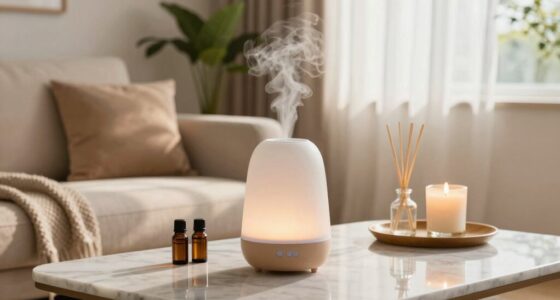
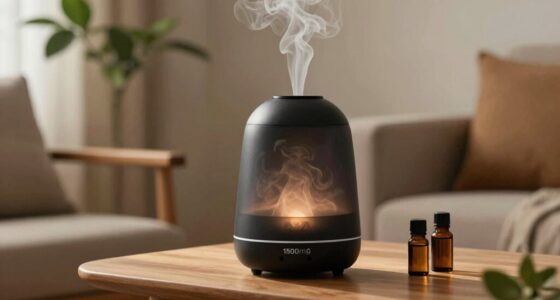
To accurately measure your scent machine’s coverage area, start by knowing your room’s size, shape, and airflow patterns. Activate the machine and observe how the scent disperses over time, noting areas that are weak or overpowering. Adjust the machine’s position or settings accordingly to achieve even distribution. Remember, real-world conditions matter more than specs alone—if you stay alert, you’ll discover key tips that boost your scent coverage efficiency.

Get oils, diffusers and self-care delivered free with Prime
- Fast, free delivery on millions of items
- Prime Video, Amazon Music and more included
- Member-only deals all year
Key Takeaways
- Measure the room’s square footage by multiplying length and width for accurate baseline coverage.
- Consider ceiling height and airflow patterns that can alter scent dispersion beyond simple area calculations.
- Conduct a trial run with the scent machine active, observing scent strength at various points to identify coverage gaps.
- Adjust placement and output settings based on real-world scent distribution rather than relying solely on manufacturer specs.
- Use proactive testing and monitoring to ensure even scent coverage, accounting for room shape, furniture, and ventilation influences.

Understanding how much area a scent machine can cover is essential for effective fragrance distribution. When you’re setting up a scent diffuser, knowing its coverage helps ensure that the scent reaches your desired space without leaving gaps or becoming overwhelming. This is where scent dispersion plays a crucial role. Scent dispersion refers to how the fragrance particles spread out from the machine into the environment. The goal is to achieve a uniform scent that enhances the space without creating hotspots or dead zones. To do this effectively, you need to understand how to perform a coverage calculation.
Coverage calculation is the process of determining the optimal placement and settings for your scent machine based on the size of the area you want to scent. It involves considering factors like ceiling height, room shape, airflow, and the machine’s output capacity. For example, a small, enclosed room may require a lower scent output or fewer dispersions compared to a large, open lobby. You should start by checking the manufacturer’s specifications, which often give an estimated coverage area. However, these are general guidelines, and real-world conditions can considerably influence performance.
Coverage calculation involves adjusting scent machine settings based on room size, shape, airflow, and manufacturer specs for optimal dispersion.
To get a more accurate picture, you need to observe how scent disperses in your specific environment. Conduct a test run by activating the scent machine and monitoring how the fragrance spreads over time. Pay attention to whether the scent evenly permeates the space or if there are areas where it’s weak or overly concentrated. Adjust the machine’s settings or placement accordingly to optimize coverage. Remember, the goal of coverage calculation isn’t just about the maximum area but about achieving an even, pleasant scent experience throughout the space.
Another key aspect of scent dispersion and coverage calculation is understanding airflow patterns. Air currents from HVAC systems, open doors, or windows can substantially influence how scent particles move. If your environment has strong airflow, you may need to position the scent machine strategically or increase the output to compensate. Conversely, in less ventilated spaces, lower settings might suffice. Recognizing airflow patterns helps you adapt your scenting strategy for consistent results.
Ultimately, effective scent coverage isn’t just about guessing or relying solely on manufacturer data. It requires active assessment and adjustment based on actual dispersion patterns. By understanding the principles of scent dispersion and performing thoughtful coverage calculation, you guarantee your fragrance reaches every corner of the space, creating a welcoming and memorable atmosphere. This proactive approach saves you from wasting scent and guarantees a consistent, pleasant experience for everyone in the room.
Frequently Asked Questions
How Does Airflow Affect Scent Coverage Calculations?
Airflow dynamics play a essential role in scent dispersal, directly impacting coverage calculations. When airflow is strong or unpredictable, it can cause scent molecules to disperse unevenly, reducing effective coverage. You need to take into account the airflow rate and direction, as they influence how scent travels throughout a space. By understanding these factors, you can more accurately estimate the scent machine’s coverage area and guarantee ideal scent distribution.
Can Coverage Area Be Increased Without Changing the Machine?
Think of your scent coverage as a garden—strategic placement makes all the difference. You can increase coverage without changing the machine by optimizing its placement and adjusting airflow to enhance scent concentration. Position the scent machine in a central, open area, and direct airflow toward high-traffic zones. This improves scent dispersion, effectively expanding the coverage area without needing a new device. Proper placement and airflow are your best tools for wider scent reach.
What Impact Does Room Shape Have on Scent Distribution?
Room shape considerably impacts scent dispersion because irregular or elongated spaces can cause uneven scent distribution. You might notice scent pooling in corners or failing to reach certain areas. To optimize dispersion, place your scent machine strategically, considering how the shape guides airflow. Rectangular rooms typically allow for more even coverage, while complex shapes may require additional scent sources or adjustments to ensure consistent aroma throughout the space.
How Often Should Scent Machines Be Recalibrated for Optimal Coverage?
You should recalibrate your scent machine every 4 to 6 weeks to maintain ideal coverage. Think of it like tuning a musical instrument—regular calibration ensures consistent scent longevity and even scent distribution. If you notice scent levels diminishing or uneven coverage, it’s time for a quick recalibration. Regular checks help prevent scent fade, ensuring your environment remains inviting and fragrant without overuse or waste.
Are There Specific Formulas for Different Scent Machine Types?
Yes, there are specific formulas for different scent machine types that help you optimize scent diffusion and machine placement. For example, ultrasonic diffusers use a formula based on room size and diffuser output, while nebulizing machines consider airflow and scent intensity. By applying these formulas, you can accurately determine the best placement, ensuring even scent coverage and avoiding scent overloads in your space.
Conclusion
Don’t let doubts hold you back—accurately measuring your scent machine’s coverage guarantees you get the most out of your investment. Yes, it might seem complex at first, but with a simple understanding of the math, you can confidently set up your scent zones. Trust me, once you master this, you’ll enjoy consistent, effective scent distribution. So go ahead, apply these tips, and transform your space with precise scent coverage—your guests will notice the difference.
Halloween Picks
halloween
As an affiliate, we earn on qualifying purchases.