
You can make sense of a GC/MS report even without a chemistry degree by focusing on the main parts: the chromatogram and the compound table. Look for the biggest peaks, which usually show the most abundant compounds, and compare the listed compounds with known standards or library matches. Pay attention to retention times and match scores, but also check the overall pattern to avoid misinterpretation. Keep exploring, and you’ll find it’s easier than it seems.

Get oils, diffusers and self-care delivered free with Prime
- Fast, free delivery on millions of items
- Prime Video, Amazon Music and more included
- Member-only deals all year
Key Takeaways
- Focus on the chromatogram’s peaks to identify the most prominent compounds, as they indicate the sample’s main components.
- Use the compound table to match retention times and molecular weights with known standards for easier identification.
- Prioritize high-abundance peaks but remain aware of smaller signals that could be significant or contaminants.
- Cross-check library match scores with retention times and fragmentation patterns for confident identifications.
- Understand that overall pattern and context are crucial; don’t rely solely on one peak or library result.
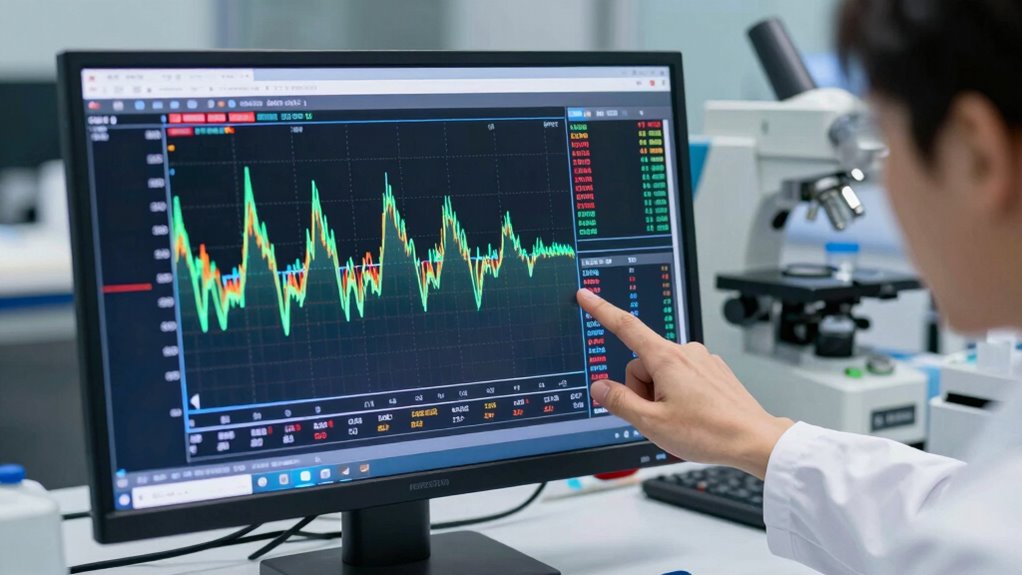
Getting clear, accurate GC/MS reports doesn’t have to be complicated. When you’re new to interpreting these reports, it can seem like reading gibberish. But with a few straightforward tips, you can confidently understand what the data means. The key lies in mastering sample interpretation and avoiding common pitfalls that trip up many beginners.
Mastering sample interpretation simplifies GC/MS reports for beginners.
First, focus on understanding the structure of the report. It typically includes a chromatogram—a graph showing peaks that represent different compounds—and a table listing those compounds with their retention times, molecular weights, and relative abundances. Your goal is to identify which compounds are present and in what quantities. To do this effectively, start by locating the primary peaks, which are usually the most intense. These indicate the most abundant compounds in your sample. Recognizing these peaks helps you prioritize which substances to analyze further.
Sample interpretation involves comparing the detected peaks against known standards or libraries. Many reports come with a library match score, showing how closely a peak matches a known compound. A high score suggests a confident identification, but always remember to verify by checking retention times and fragmentation patterns if available. Don’t rely solely on library matches—look for consistency with your sample’s expected profile. For example, if you’re testing for a specific drug or contaminant, confirm that the identified peaks align with what you anticipate based on your sample’s origin.
Avoid common pitfalls that can lead to misinterpretation. One major mistake is overlooking smaller peaks that might be significant. Sometimes, compounds present at low concentrations are essential, especially in forensic or clinical contexts. Another pitfall is assuming that a high-intensity peak always indicates a harmful or relevant compound—sometimes, it’s just a solvent or background contaminant. Always cross-reference your findings with known background signals or blanks. Also, don’t jump to conclusions based on a single match; consider the overall pattern and whether it makes sense within your sample’s context.
Additionally, understanding the fundamental principles behind mass spectrometry can help you interpret results more accurately and avoid over-reliance on automated matches. Developing a systematic approach to sample interpretation helps prevent errors and builds confidence. With practice, reading GC/MS reports becomes more intuitive. You’ll learn to distinguish meaningful signals from noise and avoid the common pitfalls that can lead you astray. Fundamentally, understanding the basics of sample interpretation transforms what once seemed like gibberish into clear, actionable insights.
As an affiliate, we earn on qualifying purchases.
Frequently Asked Questions
How Accurate Are Gc/Ms Results Compared to Other Testing Methods?
GC/MS results are highly accurate for quantitative analysis because of its sensitivity and precise detection limits. Compared to other methods, it offers superior specificity, reducing false positives or negatives. While no test is perfect, GC/MS is considered the gold standard for identifying and quantifying compounds, especially in complex samples. Your confidence in results increases with its proven track record for reliability and detailed detection capabilities.
Can Gc/Ms Detect All Types of Chemicals?
GC/MS can detect many types of chemicals, but it doesn’t catch everything. Its chemical specificity and detection limits vary depending on the compound and method used. While highly sensitive for many organic compounds, some chemicals at very low concentrations or with similar structures may be missed. So, it’s an excellent tool, but for thorough analysis, combining it with other methods ensures you don’t overlook any critical substances.
How Long Does It Take to Get a Gc/Ms Report?
Getting your GC/MS report typically takes a few hours to a day, depending on sample preparation and instrument calibration. First, you prepare your sample, which can take some time, then run it through the instrument. Once the analysis finishes, the report is generated quickly. Overall, expect a turnaround of about 24 hours, but it could be faster if your lab works efficiently and handles multiple samples simultaneously.
Is Special Training Needed to Interpret Gc/Ms Data?
Like deciphering an ancient scroll, interpreting GC/MS data doesn’t require special training, but it helps to have some background. Basic understanding of the training requirements makes you more confident, and consulting an expert can clarify complex results. While you can learn on the job, a short course or guided instruction streamlines the process, allowing you to make sense of the gibberish and confidently interpret the report.
What Are Common Mistakes When Reading Gc/Ms Reports?
You should watch out for reporting pitfalls like confusing peaks or mislabeling compounds, which often lead to data misinterpretation. Avoid jumping to conclusions based solely on initial readings; always double-check the retention times and mass spectra. Overlooking calibration errors or background noise can skew results. Being meticulous and cross-referencing data helps guarantee accurate interpretation, preventing costly mistakes caused by common misreading of GC/MS reports.
Conclusion
Now you’re ready to tackle GC/MS reports with confidence. Remember, these reports might look complex at first, but breaking them down makes everything clearer. Did you know that over 60% of new users find GC/MS data intimidating initially? With a little practice, you’ll see patterns and understand the data easily. Keep analyzing, stay curious, and soon you’ll be interpreting reports like a pro—no chemistry degree needed!
Fall Picks
fall essentials
As an affiliate, we earn on qualifying purchases.