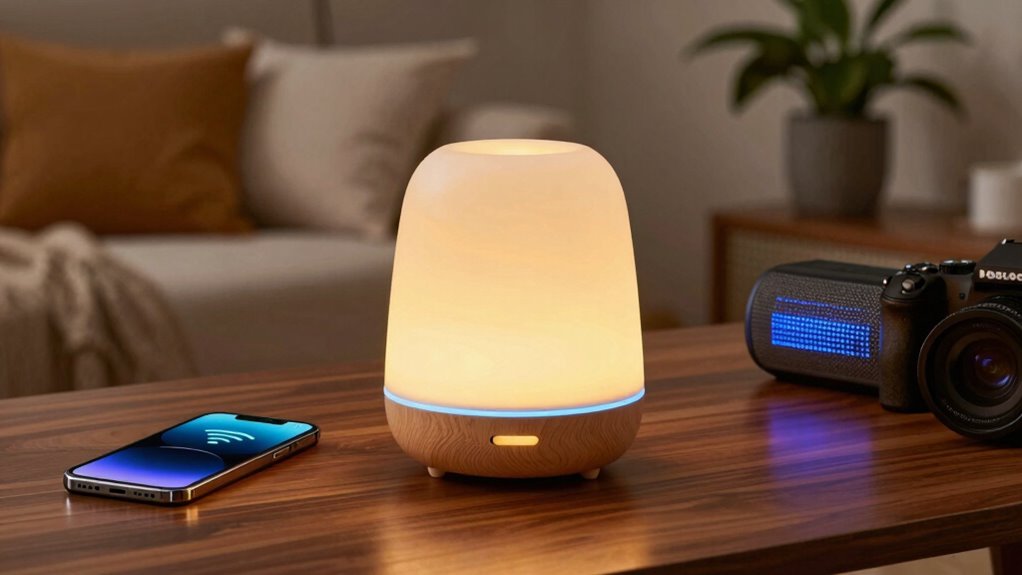

If you’re choosing between Wi‑Fi and Bluetooth for your smart diffuser, consider your needs. Wi‑Fi offers better stability over longer distances and handles large data transfers, making it ideal if you want remote control and internet connectivity. Bluetooth is simpler, faster to pair, and consumes less power, perfect for quick commands near the device. To discover which option suits your lifestyle best and reveal more details, keep exploring the differences.
Key Takeaways
- Wi‑Fi offers stronger, more stable connections over longer distances, ideal for remote control and data-heavy tasks.
- Bluetooth provides quick pairing and low energy consumption, suitable for simple, near-field commands.
- Wi‑Fi supports seamless integration with home networks and internet features, enhancing remote access.
- Bluetooth is better for short-range, low-power interactions and basic control functions.
- Overall, Wi‑Fi is preferable for stability and large data transfers, while Bluetooth excels in convenience and energy efficiency.
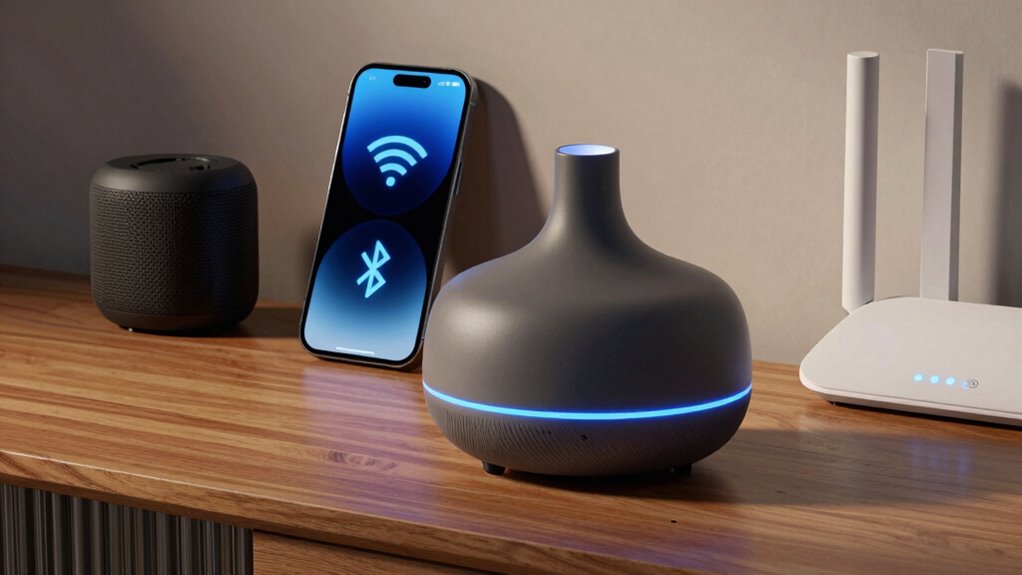
Have you ever wondered which wireless technology is better for your needs—Wi‑Fi or Bluetooth? When it comes to choosing the right connection for your smart diffuser, understanding their differences can make a big impact on your experience. Both technologies serve different purposes, and each has unique advantages that cater to specific requirements.
Wi‑Fi is designed for high-speed internet access and larger data transfers. If you want your smart diffuser to connect seamlessly with your home network and support features like remote control via a smartphone app, Wi‑Fi is likely the better choice. It offers strong connection stability over larger distances, so you won’t have to worry about frequent disconnections or signal drops as you move around your home. Additionally, Wi‑Fi tends to be more energy-efficient when used for continuous, data-heavy tasks, because it’s optimized for stable, long-term connections. This means your diffuser can stay connected without draining your device’s battery excessively, ensuring reliable operation over time.
Wi‑Fi provides stable, high-speed connections ideal for remote control and large data transfers.
Bluetooth, on the other hand, is built for short-range communication. If you’re looking for a quick, simple connection between your smartphone and your diffuser—say, to turn it on or change settings without needing internet—Bluetooth is highly convenient. It’s often more energy-efficient for small data exchanges because it consumes less power during short-range interactions. However, because Bluetooth’s connection stability can be affected by obstacles or interference from other devices, it might occasionally experience drops or lag, especially in crowded wireless environments. Still, for nearby control and basic functions, Bluetooth provides a straightforward and low-power solution, making it ideal if you prefer a device that’s easy to pair and doesn’t require a constant internet connection.
Furthermore, understanding the energy efficiency differences between the two can help you optimize your device’s battery life and overall performance. Ultimately, your choice depends on how you plan to use your smart diffuser. If you want consistent, remote access and a stable connection across your entire home, Wi‑Fi makes more sense. It ensures your device remains reliably connected, even from different rooms, and handles larger data loads efficiently. Conversely, if you prefer quick, close-range control without needing internet access, Bluetooth offers simplicity and energy savings. It’s best suited for straightforward commands and short-distance interactions.
Frequently Asked Questions
Can Wi-Fi or Bluetooth Be More Energy-Efficient for Smart Diffusers?
Bluetooth generally uses less power, helping your smart diffuser conserve battery life, making it more energy-efficient. Wi-Fi, on the other hand, consumes more power due to higher data transfer capabilities, which can drain your device’s battery faster. If you want longer battery life and lower power consumption, Bluetooth is the better choice. However, Wi-Fi offers better connectivity and remote control options, so consider your needs when choosing.
Which Connectivity Option Offers Better Security for Smart Diffuser Control?
Think of your smart diffuser’s security as a fortress protecting your sanctuary. Wi-Fi offers robust encryption protocols, making it harder for hackers to breach, but it can have hacking vulnerabilities if not properly secured. Bluetooth, with its limited range, reduces exposure but might lack advanced security features. Ultimately, Wi-Fi provides better security if you enable strong encryption, while Bluetooth’s limited access minimizes hacking risks. Choose based on your security needs and setup.
Are There Compatibility Issues Between Wi-Fi and Bluetooth Smart Diffusers?
You might encounter device compatibility issues between Wi-Fi and Bluetooth smart diffusers, especially if your devices use different protocols or outdated software. Signal interference from other electronics or Wi-Fi networks can also disrupt connectivity, causing pairing or control problems. To avoid these issues, check your device specifications, verify compatibility, and minimize interference sources. This way, you can enjoy seamless control over your diffuser without interruptions.
How Do Wi-Fi and Bluetooth Affect the Setup Process of Smart Diffusers?
You might think Wi-Fi makes setup more complex, but it actually offers better user convenience with straightforward app instructions. Bluetooth setup is usually quicker but can be limited by range, requiring close proximity during installation. Wi-Fi connections often need more steps but provide seamless remote control later. Ultimately, Wi-Fi may take a bit more effort initially, but it enhances ease of use long-term, making your smart diffuser more accessible and easier to manage.
Can Wi-Fi or Bluetooth Be Used Simultaneously in a Smart Diffuser?
Yes, your smart diffuser can use dual connectivity, combining Wi-Fi and Bluetooth simultaneously. This setup allows for more flexible control options and better interference management, ensuring stable connections even in busy environments. Using both protocols together lets you enjoy seamless operation, quick pairing, and reliable remote access. Dual connectivity is especially helpful if you want to switch between control methods or optimize performance based on your device and network conditions.
Conclusion
So, whether you prefer Wi-Fi or Bluetooth, it really depends on your needs. Wi-Fi offers more control and range, perfect for modern smart homes, while Bluetooth keeps things simple and low-energy—like a trusty rotary phone in a smartphone world. Just remember, in the age of the Internet, choosing the right tech can make all the difference. Pick what suits your style, and enjoy your diffuser without fuss, just like a well-worn pocket watch—timeless and reliable.