
Understanding scent families is key to creating enchanting fragrances. There are primary scent families like floral, citrus, woody, spicy, and fresh. Blending involves combining these scents for harmony. Start with a base note, add middle notes for balance, and finish with bright top notes. You can play with various essential oils to elevate your personal scent. With some experimentation, you’ll discover unique blends that express your emotions and memories. Keep going to uncover more about fragrance layering!
Key Takeaways
- Scent families include floral, citrus, woody, spicy, and fresh, each offering unique characteristics for blending.
- Base notes, like sandalwood, provide foundation; middle notes, like lavender, add depth; and top notes, like bergamot, offer brightness.
- Fragrance layering combines different scent families to create harmonious, personalized scents that resonate emotionally.
- Essential oils can be blended for therapeutic benefits, enhancing mood or relaxation through careful selection and experimentation.
- Achieving balance in scent blending is crucial to avoid overpowering aromas and to evoke desired feelings or memories.

Have you ever wondered why certain scents evoke specific emotions or memories? It’s fascinating how a simple whiff of a particular fragrance can transport you back to a cherished moment or trigger a feeling of calm. This phenomenon often stems from the connection between scent and the brain’s emotional centers. When you delve into the world of scent families and blending, you’ll discover how to harness this power, creating your own unique olfactory experiences.
Fragrance layering is an art that allows you to build a scent that resonates with you personally. It’s about combining different scent families—floral, citrus, woody, spicy, and fresh—to create a harmonious blend. You might start with a base note like sandalwood, which offers depth, and then layer on middle notes such as lavender for a soothing quality. Finally, a top note like bergamot can add brightness and freshness. By understanding how these layers interact, you can craft a fragrance that not only smells great but also speaks to your emotional landscape.
Fragrance layering transforms scents into personal expressions, harmonizing floral, citrus, and woody notes to resonate with your emotions.
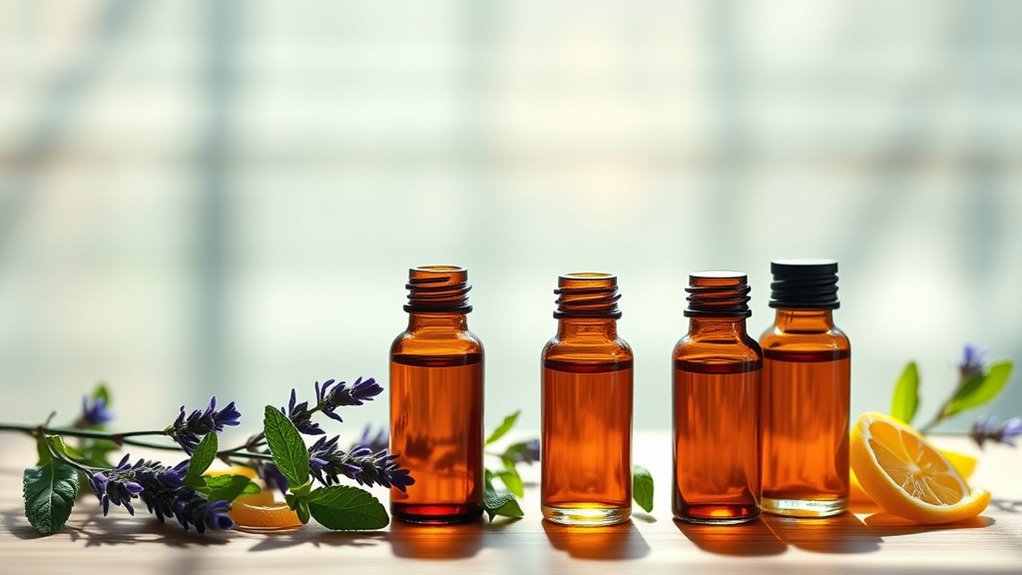
Essential oil blends are a fantastic way to explore fragrance layering. They provide a natural alternative to synthetic scents and often carry therapeutic properties. For instance, if you’re looking to uplift your mood, blending citrus oils like lemon or grapefruit with grounding oils such as cedarwood can create a revitalizing yet calming effect. You can experiment with different ratios to find what feels right, and don’t be afraid to trust your instincts. Furthermore, popular brands like Dior offer a range of fragrances that can inspire your blending journey.
As you begin to explore various essential oil blends, you’ll notice that the combinations can be endless. Try mixing floral oils like rose or ylang-ylang with herbaceous notes like rosemary to create an invigorating yet soothing scent. The key is to keep balance in mind; one overpowering scent can overshadow the others. Balance is vital in fragrance layering, ensuring that each note complements the others instead of competing for attention.
Ultimately, scent is a deeply personal experience. Through fragrance layering and essential oil blends, you can create a signature scent that captures your essence and enhances your surroundings. Whether you’re looking to evoke memories, inspire creativity, or simply enjoy the beauty of well-crafted aromas, the journey into scent families and blending can be incredibly rewarding. So, grab your oils and start experimenting—your perfect fragrance awaits!
Frequently Asked Questions
How Do Scent Families Influence Personal Fragrance Choices?
Scent families considerably influence your personal fragrance choices by aligning with your fragrance personality. When you explore different scent families, you discover what resonates with your scent preference influences. For instance, if you gravitate towards floral notes, it reflects your romantic side, while woody scents might showcase your earthy, grounded nature. Understanding these connections helps you select fragrances that not only smell good but also express who you are, enhancing your overall experience.
Can I Create My Own Scent Family at Home?
Absolutely, you can create your own scent family at home! Start with DIY scent crafting by gathering essential oils that resonate with you. Experiment with different combinations to find what feels right. Consider your favorite notes and how they blend together. With scent family customization, you’ll discover unique fragrances that reflect your personality. Don’t be afraid to tweak and refine your mixtures until you’ve crafted the perfect scent that’s all your own!
What Tools Do I Need for Scent Blending?
To plunge into scent blending, grab a sturdy glass dropper, small mixing bottles, and a notebook to capture your creative journey. Stock up on essential essential oils—think citrusy, floral, and earthy scents that dance together. A scale helps you measure precise drops, while blending techniques like layering and pairing will elevate your creations. With each blend, you’ll craft fragrant memories, weaving aromas that tell your unique story. Enjoy the art of discovery!
Are There Any Safety Precautions for Blending Scents?
Yes, there are important safety precautions for blending scents. Always check essential oil safety guidelines, as some oils can cause irritation or sensitization. Start with small amounts to test for allergies, and avoid skin contact with undiluted oils. Wear gloves to protect your skin, and work in a well-ventilated area. Keep essential oils away from children and pets, and store them safely to prevent accidental ingestion or misuse.
How Do Different Cultures Perceive Scent Families?
Did you know that over 90% of people associate specific scents with memories? Different cultures perceive scent families through unique cultural scent preferences and classification systems. For instance, while Western cultures might favor floral scents for their freshness, many Eastern cultures appreciate earthy aromas for their grounding qualities. This diversity highlights how deeply scent influences our emotions and experiences, shaping our connections to traditions, environments, and even personal identities.
Conclusion
In exploring scent families and mastering blending basics, you’ve opened a world of olfactory possibilities. You’ve learned to identify floral and woody, citrus and spicy, to create harmonious fragrances that resonate with your style. You’ve discovered how to balance notes and elevate your creations, enhancing your sensory experiences. So, embrace your creativity, experiment boldly, and let your unique scents tell your story. With each blend, you’re not just crafting fragrances; you’re weaving memories and evoking emotions.