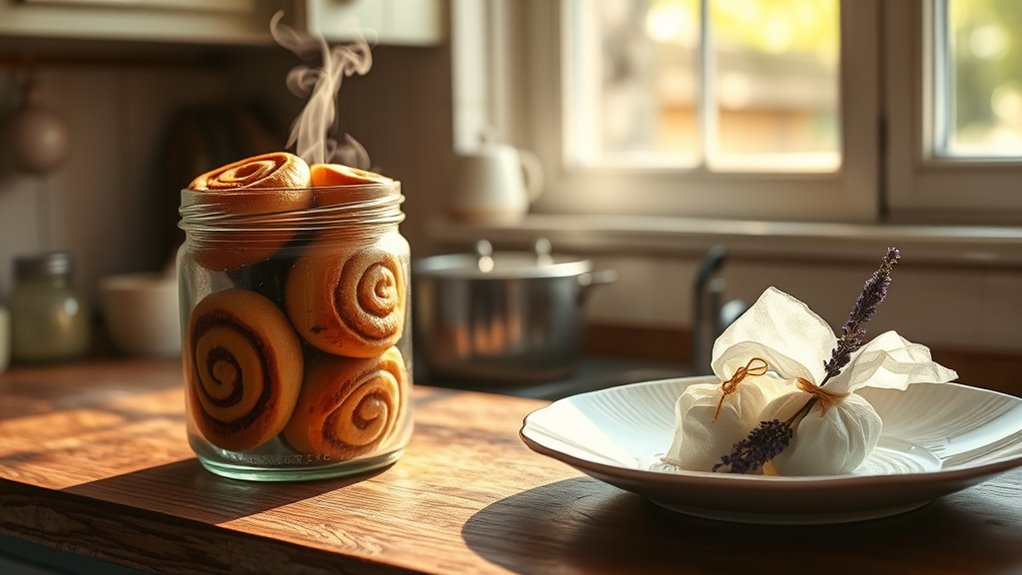

Your sense of smell directly connects to brain areas that control memory and emotion, making scents powerful triggers for vivid memories. When you encounter a familiar smell, signals bypass usual pathways and activate the limbic system, which processes feelings and memories. This unique route allows scents to evoke emotions and recall moments long forgotten. If you keep exploring, you’ll discover how olfactory cues shape your personal experiences and emotional life in remarkable ways.
Key Takeaways
- Smells directly connect to the brain’s emotional and memory centers via the olfactory bulb and limbic system.
- The olfactory system bypasses usual relay stations, making scent-triggered memories more immediate and intense.
- Specific scents are linked to meaningful personal experiences, creating strong, long-lasting emotional associations.
- Olfactory memories are resilient, often evoking vivid recollections even years later.
- The deep neural connection between scent and emotion explains why smells can instantly recall powerful memories.

Have you ever noticed how a single scent can instantly transport you back to a specific moment or place? That’s no coincidence. It’s your olfactory pathways at work, connecting your sense of smell directly to the parts of your brain responsible for memory and emotion. When you smell something familiar, tiny molecules travel through your nose and activate receptors that send signals straight to the olfactory bulb, which is located just above your nasal cavity. From there, these signals are relayed to the limbic system—a complex network of brain structures that govern emotions and memories. This direct neural connection explains why smells can evoke such vivid and intense emotional associations and memories.
Unlike other senses, the olfactory system bypasses the usual relay stations in the brain, giving scent a unique power to trigger emotional responses. When a particular smell is linked to a meaningful event—like the smell of fresh baked cookies reminding you of your grandmother’s kitchen or a certain cologne bringing back a first date—it forms a strong emotional association. These associations are stored in the brain as part of your long-term memory, making the scent a potent cue that can bring those moments rushing back in an instant. That’s why a whiff of something familiar can make you feel joy, nostalgia, or even sadness, often without any conscious awareness of the connection.
Your emotional associations with scents are deeply rooted in your personal experiences, and they can be surprisingly resilient. Even years after an event, a particular smell can evoke memories with startling clarity. This is why certain fragrances or aromas can instantly lift your mood or evoke a sense of comfort, taking you back to a specific time and place with remarkable precision. It’s also why scent plays such a crucial role in branding and marketing—companies harness the power of olfactory cues to create emotional bonds with their audience.
Understanding how olfactory pathways link smells to emotions helps you appreciate why some scents carry so much emotional weight. They aren’t just pleasant or unpleasant smells—they’re powerful triggers woven into the fabric of your personal history. Every whiff has the potential to reveal a treasure trove of memories, reminding you of moments long past and feelings long held. It’s a fascinating dance between your nose, brain, and heart, showing just how deeply scent is intertwined with who you are.
Frequently Asked Questions
Can Scents Influence Our Emotional Well-Being Long-Term?
Scents can influence your emotional well-being long-term through processes like olfactory conditioning and scent nostalgia. When you associate certain smells with positive experiences, those scents can boost your mood over time. Conversely, unpleasant odors might trigger negative feelings. Regularly experiencing pleasant scents helps reinforce positive emotional responses, shaping your overall well-being. So, your environment’s scents play a significant role in maintaining or improving your emotional health long-term.
Are There Specific Scents Linked to Particular Memories?
Oh, the grand mystery of fragrant associations—surely, scents are just random whiffs, right? Actually, your olfactory triggers are quite specific; lavender might remind you of grandma’s garden, while fresh baked cookies evoke childhood joy. Certain scents are deeply linked to particular memories, thanks to your brain’s powerful ability to connect smells with emotional experiences. So yes, some smells are uniquely tied to your most treasured moments.
How Do Scents Affect Children’S Memory Development?
You might not realize it, but scents play a vital role in children’s memory development through olfactory imprinting. As they reach sensory milestones, their brains connect smells with experiences, helping shape their memories. When you introduce new scents during important moments, you’re strengthening these neural pathways. This process makes scents especially powerful in forming lasting memories, influencing how children remember and interpret their world over time.
Can Scent-Based Therapies Improve Memory Loss?
You might wonder if scent-based therapies can improve memory loss. Research shows that olfactory training and scent recognition exercises help stimulate your brain’s memory centers. By regularly exposing yourself to specific scents, you can potentially enhance neural connections and boost recall abilities. While not a cure, these therapies offer a promising way to support memory retention, especially when combined with other treatments.
Do Cultural Differences Affect Scent-Memory Associations?
Imagine walking through a market, scents swirling around you, each one telling a story. Cultural scent perceptions shape how you interpret these smells, creating unique memories. Cross-cultural scent associations influence which fragrances evoke nostalgia or emotion, revealing that your scent-memory links aren’t universal. Your experiences are deeply rooted in your culture, making scent-triggered memories as diverse as the traditions that define them.
Conclusion
So, next time a whiff of grandma’s perfume or a bakery’s scent hits you unexpectedly, don’t dismiss it as mere coincidence. It’s nature’s way of reminding you that your brain’s favorite party trick—turning smells into vivid memories—still works flawlessly. After all, who wouldn’t love a reminder of their childhood or that awkward first date, delivered via aroma? Smell truly is life’s most poetic and mischievous storyteller, isn’t it?